See this design live
Open the real, interactive design — exactly what your recipient sees.
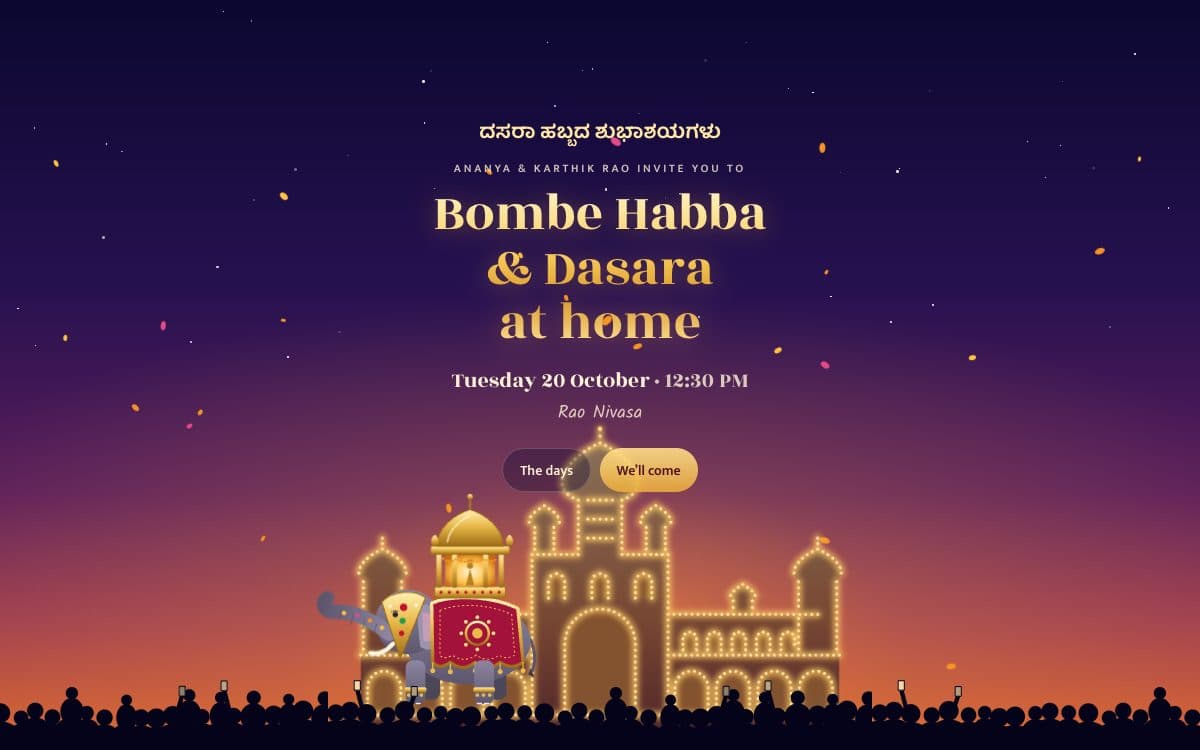
Every Dasara evening at seven, the Mysuru palace lights up — nearly a lakh bulbs coming on at once — and the whole city gasps like it is seeing it for the first time. A good Dasara invitation should feel a little like that moment. It is not one event: it is ten days of dolls on the steps, haldi-kumkum evenings, the Ayudha Pooja, a Vijayadashami lunch and banni for everyone before they leave, and the people you love need to know which of those days you are hoping to see them. This guide gives you the 2026 dates, the Navratri colours day by day, more than twenty Dasara invitation messages for WhatsApp — in English, Kannada, Hindi, Marathi, Tamil and Telugu — and the wording for Bombe Habba, Golu and an office Ayudha Pooja. And if you would rather send something your family will actually remember, it shows you how to make a Dasara invitation card online that lights its own palace when they open it.
Dasara 2026 dates: Navratri, Ayudha Pooja and Vijayadashami
In 2026 the festival runs from Sunday 11 October to Wednesday 21 October. These are the days most families plan around:
- Navratri begins (Ghatasthapana): Sunday 11 October 2026 — the dolls go up and the first evening of haldi-kumkum begins
- Ayudha Pooja / Maha Navami: Monday 19 October 2026 — tools, vehicles, books and laptops are worshipped
- Vijayadashami (Dasara): Tuesday 20 October 2026 — the festive lunch, Saraswati's blessing for new beginnings, and banni (shami) leaves given as gold
- Mysuru Jamboo Savari: Wednesday 21 October 2026 — the elephant procession carrying the golden Ambari
Timings differ slightly between regional calendars, so check your family panchang for the exact muhurat before you put a time on the invitation.
When to send it: send a Dasara or Bombe Habba invitation four to six days before Navratri begins — that is, around 5 to 7 October 2026 — so people can plan which evenings to visit. Send one short reminder the day before Ayudha Pooja and again on the morning of Vijayadashami. With a link, a reminder is simply the same invitation forwarded again.
Navratri 2026 colours, day by day
Because Navratri 2026 begins on a Sunday, the colour sequence most families follow starts with orange. Guests love being told the colour in advance, and it is a lovely line to add to an invitation.
- Day 1 — Sunday 11 October: Orange
- Day 2 — Monday 12 October: White
- Day 3 — Tuesday 13 October: Red
- Day 4 — Wednesday 14 October: Royal Blue
- Day 5 — Thursday 15 October: Yellow
- Day 6 — Friday 16 October: Green
- Day 7 — Saturday 17 October: Grey
- Day 8 — Sunday 18 October: Purple
- Day 9 — Monday 19 October: Peacock Green
The nine colours are a much-loved custom rather than a rule, and some regions follow their own. Our Ambari design shows all nine with their dates and picks out today's colour automatically, so a guest who opens your invitation on the 14th sees "Royal Blue" glowing at the top of the grid.
Dasara invitation messages for WhatsApp (copy and paste)
Copy any of these, change the words in brackets, and paste your invitation link on the line below. They are written to sound like a person, not a printed card.
Dasara at home — warm and simple
Dasara greetings! 🙏 The dolls are up, the house smells of sundal, and we would love to have you with us this year. Join us for Vijayadashami lunch on Tuesday, 20 October at [Time], [Address]. Everything — the days, the map and the timings — is in the link.
Bombe Habba / Gombe Habba invitation
Our Bombe Habba is up! 🪔 Ajji's pattada gombe are back on the top step, along with a few new friends. Do drop in any evening between 11 and 20 October, 6 to 9 pm, for haldi-kumkum, sundal and a look at the dolls. — [Family Name]
Golu invitation (Navratri Kolu)
Navaratri wishes! 🙏 Our Golu is ready — nine steps this year. Please come with family any evening from 11 to 19 October, after 6 pm, for vethalai-paaku and sundal. [Address] — the full timings and map are in the link.
Navratri haldi-kumkum invitation
Happy Navaratri! 🌼 We are keeping haldi-kumkum on [Day, Date] from [Time]. Please come and take thamboola from us — and wear [Colour], it is the colour of the day! [Address]
Vijayadashami lunch invitation
Shubh Vijayadashami! 🙏 On Tuesday, 20 October we are having a banana-leaf lunch at home at [Time], and there is banni for everyone before you leave. Do come with family. [Address]
Inviting someone for one particular day
We would really love to see you on [Day] evening — it is the Ayudha Pooja and the whole family will be home. Come by any time after [Time]. The rest of the days are in the link if that one doesn't work.
For family who live far away
We wish you were here for Dasara this year. 🪔 The dolls, the days and photos of the steps are all on this link — open it when it is evening where you are, and leave us a wish on the page. We will read it out at the pooja.
Navratri invitation for a housing society
[Society Name] Navratri Utsav 2026 🙏 Ghatasthapana on Sunday 11 October at [Time]. Garba and dandiya every evening from [Time] in the clubhouse, Ayudha Pooja on 19 October and the Dasara get-together on 20 October. All residents and families are invited — schedule and colours of the day in the link.
Short and sweet for a busy group
Dasara at ours! 🪔 Dolls up 11–20 Oct, 6–9 pm | Vijayadashami lunch 20 Oct, [Time] | [Address]. Tap for the days and directions.
Jamboo Savari plan with friends
Mysuru Dasara plan! 🐘 We are watching the Jamboo Savari together on Wednesday, 21 October from [Place]. Meet at ours at [Time], and bring a cap and water. Details and map in the link.
A small tip that makes a big difference: if you are inviting people for several evenings, say so in the first line. "Any evening between the 11th and the 20th" turns a formal invitation into an open door, and that is exactly how Bombe Habba is meant to feel.
Dasara invitation messages in Kannada, Hindi, Marathi, Tamil and Telugu
Most families mix languages on WhatsApp, and elders always appreciate an invitation in their own. These are short, respectful and easy to personalise.
Kannada — Dasara and Bombe Habba
ನಾಡಹಬ್ಬ ದಸರಾ ಹಬ್ಬದ ಶುಭಾಶಯಗಳು! 🙏 ನಮ್ಮ ಮನೆಯ ಬೊಂಬೆ ಹಬ್ಬಕ್ಕೆ ಮತ್ತು [Date] ರಂದು ವಿಜಯದಶಮಿ ಊಟಕ್ಕೆ ತಾವು ಸಕುಟುಂಬ ಸಮೇತರಾಗಿ ಬರಬೇಕೆಂದು ಆತ್ಮೀಯ ಆಹ್ವಾನ. — [Family Name]
Hindi — Dussehra invitation
दशहरे की हार्दिक शुभकामनाएँ! 🙏 विजयादशमी के पावन अवसर पर [Date] को [Time] बजे हमारे घर पूजा और भोजन के लिए आप सपरिवार सादर आमंत्रित हैं। पता: [Address] — [Family Name]
Marathi — Dasara invitation
दसऱ्याच्या हार्दिक शुभेच्छा! 🙏 विजयादशमीनिमित्त [Date] रोजी [Time] वाजता आमच्या घरी पूजा व स्नेहभोजनासाठी आपण सहकुटुंब यावे, ही आग्रहाची विनंती. — [Family Name]
Tamil — Golu invitation
நவராத்திரி வாழ்த்துக்கள்! 🙏 எங்கள் வீட்டு கொலுவுக்கு [Date] முதல் [Date] வரை தினமும் மாலை [Time] மணிக்கு குடும்பத்துடன் வருமாறு அன்புடன் அழைக்கிறோம். — [Family Name]
Telugu — Dasara invitation
దసరా శుభాకాంక్షలు! 🙏 విజయదశమి సందర్భంగా [Date] న మా ఇంటికి పూజ మరియు భోజనానికి కుటుంబ సమేతంగా రావలసిందిగా ఆహ్వానిస్తున్నాము. — [Family Name]
The Ambari invitation has a line for a greeting in your own script — type ದಸರಾ ಹಬ್ಬದ ಶುಭಾಶಯಗಳು, दशहरे की शुभकामनाएँ or நவராத்திரி வாழ்த்துக்கள், and it sits in gold above your title.
Ayudha Pooja invitation message for employees, customers and the shop
Ayudha Pooja is the one day of Dasara that belongs to the workplace as much as the home. Offices, factories, shops and garages invite their teams, families and regular customers, and the invitation needs to be clear about time, place and whether families are welcome.
Ayudha Pooja invitation to employees
Dear team, 🙏 we are celebrating Ayudha Pooja at [Office / Factory Name] on Monday, 19 October 2026. The pooja begins at [Time], followed by lunch for everyone. Your families are most welcome. The office will be closed on Vijayadashami, 20 October. — [Name], [Company]
Ayudha Pooja invitation for customers and suppliers
Ayudha Pooja greetings from all of us at [Business Name]! 🙏 We would be honoured to have you with us for the pooja on Monday, 19 October at [Time], at [Address]. Thank you for being part of our year.
Shop or garage, short version
[Shop Name] Ayudha Pooja 🙏 Monday, 19 Oct, [Time] | Pooja, sweets and prasad | All our customers and friends are invited. [Address]
For a workplace invitation, add who to contact on the day, whether there is parking, and what time lunch is served. If families are coming, say whether children are welcome — it saves a dozen messages to HR.
What to include in a Dasara invitation card
A Dasara invitation is festive first and practical second — but it has to be both, because guests are coming to a real address on one or more of ten days. Make sure yours has:
- The host family's name and, ideally, who is inviting (a grandmother's name on a Bombe Habba invitation makes elders feel personally asked)
- Which days you are celebrating — the doll-viewing evenings, Ayudha Pooja, Vijayadashami lunch — each with its date and time
- A clear time window for open evenings, such as 6 to 9 pm, so people do not arrive while you are mid-aarti
- The full address and a map link — apartment blocks, gate numbers and landmarks matter during festival traffic
- What to wear, if you have a preference — the colour of the day is a fun touch
- A way to reply with which days they will come, so you know how much sundal to make
- A line about the dolls or the family — the story behind your pattada gombe is the part people remember
Printed cards could never hold all of that legibly, and a forwarded image goes stale the moment one time changes. A link can hold everything, update if plans change, and still look beautiful.
Meet Ambari: an animated Mysuru Dasara invitation
We built Ambari for families who want their Dasara invitation to feel like the festival itself.
It opens at dusk in Mysuru: a violet sky, the palace dark, a crowd waiting with their phones up. Your guest taps "Light the palace" — and the bulbs come on in a wave from the golden dome down, just as they do at seven every Dasara evening. Then an elephant in a red-and-gold jhool walks in carrying the golden Ambari and raises its trunk in greeting. Only then does your invitation appear, in gold, above the lit palace.
Inside, it carries everything a Dasara invitation needs:
- A letter from the family, in a handwritten style, opening with your guest's name
- Every day of the festival on its own card, coloured in that day's Navratri colour, with an "Add to calendar" button
- The nine Navratri colours with their dates — and today's colour picked out automatically
- The Bombe Habba steps, with Channapatna-style dolls that wiggle when a child taps them, and your family's story about your dolls
- Directions and a map to your door
- An RSVP that asks which days they will come and how many of them — it reaches you as one WhatsApp, text or email message
- Banni at the end: your guest taps "Take the banni", the leaves turn to gold, and your Vijayadashami wish appears
- A wishes wall where relatives leave their blessings for everyone to read
You can address it to each family too. Add ?to= and their name to the end of your link — for example, …?to=Shalini+and+family — and the invitation greets them by name before the palace lights up.
It is a one-time ₹399 to publish, with no per-guest charge, and you can build and preview before you pay.
How to make your Dasara invitation online in five minutes
- Open the Ambari design and tap "Use this design". You do not need an account to start.
- Add your names — who is hosting, what you are celebrating ("Bombe Habba & Dasara at home") and, if you like, a greeting in your own language and a family photo.
- Add the days — the doll evenings, Ayudha Pooja, Vijayadashami lunch, even the Jamboo Savari plan — each with a date, time and a line about it.
- Add the address and map link, and the Navratri start date if you want the colours of the day.
- Write your letter and your banni wish. A few honest lines about what Dasara means in your house will do more than any poem.
- Preview it exactly as your guests will see it, light the palace yourself, then publish and share the link on WhatsApp.
Because it is a link rather than an image, you can send the same invitation to the family group, the building group and the cousins abroad, and it looks right on every phone.
Bombe Habba and Golu etiquette: inviting, visiting and thamboola
The beauty of Bombe Habba is that it is an open house. A few gentle customs make it easier for everyone:
- Invite women of the family and neighbourhood by name. Haldi-kumkum invitations traditionally go from the lady of the house, and a personal line ("We would love to see you and Ammu on Thursday") means far more than a group forward.
- Give a window, not a single time. People visit several homes in one evening during Navratri. "Any day, 6 to 9 pm" lets them plan a route.
- Keep thamboola ready. Betel leaves, a coconut or fruit, kumkum and a small gift are given to married women and girls who visit — most families prepare a basket for each evening.
- Tell the story of your dolls. Guests always ask about the oldest pattada gombe or the newest addition. Putting that story in the invitation makes the visit feel like part of your family's history.
- Children are the heart of it. Encourage them to bring a friend — and let them tap the dolls on the invitation before they come and see the real ones.
Quick checklist
- Confirm the exact muhurat and pooja timings from your family panchang before you publish.
- List every day you are celebrating — doll evenings, Ayudha Pooja and Vijayadashami lunch — with a date and time.
- Give a time window for open evenings so guests can plan visits to several homes.
- Add the full address, gate or flat number and a Google Maps link.
- Add the Navratri start date so guests see the colour of the day.
- Write a short line about your dolls or your family tradition.
- Send the invitation around 5–7 October 2026, with reminders before Ayudha Pooja and on Vijayadashami morning.
Frequently asked questions
In 2026 Navratri begins on Sunday 11 October, Ayudha Pooja and Maha Navami fall on Monday 19 October, Vijayadashami (Dasara) is on Tuesday 20 October, and the Mysuru Jamboo Savari is on Wednesday 21 October. Regional calendars can differ slightly, so check your panchang for exact muhurat timings.
Navratri 2026 starts on a Sunday, so the commonly followed sequence is: Orange (11 Oct), White (12 Oct), Red (13 Oct), Royal Blue (14 Oct), Yellow (15 Oct), Green (16 Oct), Grey (17 Oct), Purple (18 Oct) and Peacock Green (19 Oct).
Start with a Dasara greeting, say which days you are celebrating and at what times, give the full address with a map link, and add a personal line — about your dolls, the family or why you would love to see them. End with how to reply. The samples above can be copied and personalised in a minute.
Send one invitation link that lists the evenings your dolls are up, a time window such as 6 to 9 pm, and your address. Mention any special evening like haldi-kumkum separately. A digital invitation lets guests see all the days at once and reply with the ones they will come to.
Yes. You can write the whole message in any language, and the Ambari design has a separate greeting line that shows Kannada, Hindi, Marathi, Tamil, Telugu or any other script in gold above your title.
It is a one-time ₹399 to publish, with no subscription and no per-guest charge. You can add every detail and preview the whole invitation before you pay.
No. Your invitation is a link that opens in any phone browser — on WhatsApp, SMS, Instagram or email. Guests tap it, light the palace and read everything without installing anything.
Yes. The RSVP lets each guest pick the days they will come and how many of them there are, and sends it to you as a single WhatsApp, text or email message — so you know who to expect each evening.