The invitation budget conversation at most Indian wedding planning sessions goes something like this: the family sits down, someone mentions a figure, someone else says that is not enough for good quality, and then the number quietly doubles before anything specific has been decided. This happens partly because invitation costs are genuinely opaque (most families do not know what things actually cost until they are already talking to a printer) and partly because the invitation is the first public-facing piece of the wedding, and no one wants to look like they cut corners on the first impression. The good news is that the options available in 2026 make it genuinely possible to have a high-quality wedding invitation experience at a fraction of what families were spending five years ago. Not because anyone lowered their standards, but because digital invitations changed the economics of the whole category. The budget-friendly path now is not to compromise on quality; it is to allocate the invitation budget more carefully between what guests actually notice and what they do not. Working with families on ShareInvite, I can tell you what guests notice. It is not the weight of the paper. It is not whether the envelope has a wax seal. It is whether the invitation tells them where to go, when to be there, and whether it feels like it was made by someone who cared. All of that is achievable without the budget that most families assume they need.
Where the invitation budget actually goes, and where it does not need to
Most Indian wedding invitation budgets are allocated across three things: design, printing, and distribution. Of these, distribution is the largest hidden cost, not in direct money but in time and coordination. Getting five hundred printed cards into the right hands before a wedding involves personal deliveries, couriers, and postage, plus the follow-up to confirm receipt. This coordination cost rarely appears in the invitation budget but is real.
Design is the second area where families overpay for things that do not create value. A custom hand-lettered design on thick cotton paper costs significantly more than a well-chosen template. For the majority of guests who will see the card once, quickly, and then tuck it into a drawer, the difference in design investment is invisible. The guests who care about the design are usually the couple themselves and a small circle of close family, not the four hundred people receiving the card.
Printing itself is where the cost differences are most visible and most negotiable. The range between budget printing and premium printing is enormous. A basic offset print run costs dramatically less than letterpress or foil-stamped cards, but most guests receiving the basic print cannot tell the difference unless they are specifically looking for it. The tactile premium of a luxury card is meaningful for perhaps twenty guests. For the other four hundred and eighty, it is invisible.
The budget insight that consistently surprises families: the per-card cost of printing is much lower for the elders-and-inner-circle list than they expect, because that list is short. Twenty-five beautiful printed cards cost a fraction of five hundred mid-range ones, and look better.
The real cost of a digital invitation, and what that frees up
A premium digital invitation on ShareInvite costs ₹499. That is the complete cost: design, distribution, unlimited guests, all features. No courier. No printing. No envelope stuffing. The same link goes to four hundred and fifty guests simultaneously.
What does ₹499 deliver? A professionally designed invitation page with the couple's names in premium display typography, a photo gallery, background music, a Google Maps link, a ceremony schedule, a countdown timer, a guest wishes section, and a shareable WhatsApp link that generates a preview card when forwarded. The WhatsApp preview (the thumbnail image and title that appears before guests open the link) is often more visually striking than a WhatsApp-forwarded image of a printed card.
What this frees up in the invitation budget is significant. If a family was planning to spend ₹30,000 on a full print run for three hundred guests, shifting to a digital invitation for the broad guest list and a thirty-card premium print run for the inner circle costs roughly ₹5,000 to ₹8,000 total, a saving of ₹22,000 to ₹25,000. That money can go toward catering, decor, photography, or just back into the family's budget. It does not need to go anywhere; the invitation is genuinely handled.
For families planning their first major event on a real budget (younger couples, families without the multi-generation wedding planning infrastructure that some joint households have), this math changes the conversation entirely. The invitation is no longer a large line item.
Budget ideas that actually work, and the ones that look cheap
There are budget moves that save money without any visible compromise, and there are budget moves that guests notice in an unflattering way. Knowing which is which saves families from false economies.
Budget moves that work: Digital invitation for the bulk of the guest list (guests genuinely prefer the navigability). A shorter, well-designed printed card for the inner circle (twenty to thirty cards, quality over quantity). A simple but clearly readable WhatsApp sharing message rather than an elaborate image file (image files degrade on forwarding; links do not). Choosing a pre-designed digital template over a custom-built one (the best ShareInvite templates are better than most custom work in the same price range).
Budget moves that look cheap: Low-resolution printed cards where the text is hard to read. Cards printed on thin paper that feel flimsy. Photocopy-quality printing. A digital invitation with a placeholder photo or no photo at all. A WhatsApp image file so compressed from forwarding that the text is illegible. These are the things guests notice, even if they do not say so.
The general principle: cut on quantity, not quality. Thirty beautiful cards cost less than three hundred mediocre ones. One well-designed digital invitation reaches five hundred people for ₹499. The budget path is not to make a worse invitation for more people. It is to make a better invitation and distribute it more efficiently.
What couples overlook: the small investments with the biggest impact
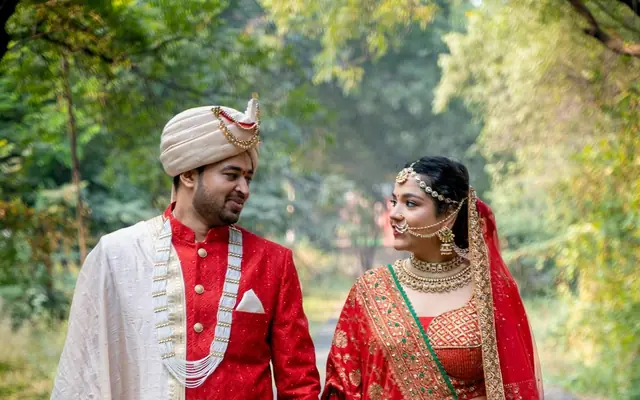
The single highest-impact element of any digital invitation is the photo. Families spend significant money on print design and then use a blurry phone photo from two years ago. The photo budget should be zero, but the photo choice should be deliberate. A good phone photo in natural light, with both people looking at ease, does more work than a professional studio portrait shot in flat indoor lighting. The couples who take twenty minutes to find the right photo before publishing their invitation consistently get more wishes, more responses, and more comments at the event.
Background music is the second overlooked investment. On ShareInvite, adding music to an invitation costs nothing extra: it is included in the feature set. But most couples either skip it or use the default option. An invitation that plays a song the couple actually loves, from the moment it opens, creates an experience rather than just displaying information. Guests who open an invitation and hear music that surprises or moves them comment on it. Guests who open an invitation with no music comment on nothing.
The wishes section deserves planning, not an afterthought. Enabling it is a checkbox; actually getting guests to leave wishes requires that the host mention it in the sharing message. "Use the link below to see all the details, and leave a blessing for [Couple] on the page" doubles the number of wishes received compared to just sending the link. This takes five extra words in the WhatsApp message and costs nothing.
A realistic invitation budget breakdown for Indian weddings in 2026
For a wedding of three hundred guests, here is what a well-considered budget allocation looks like in 2026, based on patterns I see work consistently.
Digital invitation for the broad guest list (₹499): This covers everyone who will receive the invitation primarily through WhatsApp: friends, work colleagues, extended family, neighbours. All features included. Shareable to any number of guests for this flat cost.
Premium printed cards for the inner circle (₹3,000–₹6,000): Twenty-five to thirty cards, well-printed on good paper, with envelopes. These go to immediate family on both sides, close elders, and the handful of people for whom a physical card is culturally the right choice. At this quantity, a good printer can produce quality work for this range.
Delivery of printed cards (₹0–₹1,500): For a list of twenty-five to thirty, most can be hand-delivered by family members visiting relatives over the two-week period before the wedding. A small number may need to be posted, which adds minimal cost.
Total invitation spend: ₹4,000–₹8,000 for a three-hundred-guest wedding. Compare this to ₹25,000–₹50,000 for a full printed run with delivery. The difference is real money that shows up in the wedding budget elsewhere.
The families who feel most at peace with their invitation spending, in my experience, are not the ones who spent the least. They are the ones who understood what they were buying. When you know that the ₹499 digital invitation is reaching everyone who will actually use the map and schedule, and the ₹5,000 printed cards are going to the thirty people for whom the physical card carries meaning, the spend feels intentional rather than squeezed.
Quick checklist
- Print only for the inner circle: twenty-five to thirty cards is almost always enough for the people who truly need a physical card.
- Use a premium digital template (₹499) for the broad guest list. It looks better than a forwarded image file.
- Spend time choosing the right photo. It is free and has the highest impact on how the invitation is received.
- Enable background music and pick something the couple actually listens to, not the default.
- Mention the wishes section explicitly in the WhatsApp sharing message to increase guest participation.
- Pin the Google Maps link to the main gate, not the building. This is the detail guests use most on the event day.
- Send out-of-city guests the invitation 3–4 weeks early. This is the group most likely to need lead time.
- Budget for the reminder, not just the initial send. Resharing the link two days before is the most effective second touch.
Frequently asked questions
A well-allocated invitation budget for 300 guests in 2026 is ₹4,000 to ₹8,000. This covers a ShareInvite premium digital invitation (₹499) for the broad guest list and 25–30 quality printed cards (₹3,000–₹6,000) for elders and inner circle. A full printed run for 300 guests typically costs ₹20,000–₹50,000 with design and delivery. The digital-plus-selective-print approach costs significantly less and serves the guest list better.
For most guests, yes. A digital invitation on ShareInvite is widely accepted and often preferred because of the navigation and schedule features. The guests who specifically need a printed card are usually a small group: elderly family members without smartphones, and close relatives for whom a physical card is culturally meaningful. For those 20–30 people, a printed card is worth printing. For everyone else, a digital invitation communicates as much care at a fraction of the cost.
The non-negotiables are: a clear photo of the couple, the ceremony schedule with all event timings, the venue address with a Google Maps pin, and a shareable WhatsApp link that generates a proper preview card. Background music and a guest wishes section are low-cost additions that significantly improve how the invitation is received. Everything else (custom typography, elaborate design, premium packaging) is optional and often invisible to most guests.
The three things that make a wedding invitation look expensive without actually being expensive: a great couple photo (free, requires only good light and a good moment), a premium template with quality typography (₹499 on ShareInvite), and background music that fits the mood (included). The design variables that feel premium to guests are these three things, not paper weight or envelope type, which guests assess briefly and forget. A digital invitation that does these three things well consistently reads as high-quality across all guest demographics.