Most engagement invitations get scrolled past in about two seconds. The couple's names appear, the date appears, and the guest moves on to the next notification in their WhatsApp. The invitations that actually get read, that get screenshotted and forwarded and talked about at the event itself, are doing something specific. They feel like they were made by someone who cared, not by someone who filled in a template and hit send. Across the engagement invitations created on ShareInvite, the pattern is consistent. It is not the most ornate designs that generate the most wishes and the most genuine responses. It is the ones where the couple uploaded a real photo, wrote one personal line, and used the right name for their ceremony. A couple from Pune who used a photo from their road trip to Coorg got three times more wishes than couples who used a formal portrait from a studio, not because the photo was technically better, but because it communicated something true about who they are. This guide is about the ideas that actually work for engagement invitations in Indian families, across ceremony types, family structures, and how people actually share things on WhatsApp. It will also tell you what does not work, because there are a few common mistakes that are easy to avoid once you know what to look for.
The first thing guests see, and why most invitations get it wrong
The first thing a guest sees when they open an engagement invitation link is not the couple's names. It is the photo, or the absence of one. Invitations that use a placeholder graphic or leave the photo section blank read as incomplete, regardless of how well-written the rest of the content is. The photo communicates that the couple exists, that there is a real story here, and that this invitation was made with effort.
The second mistake is trying to say everything in the opening. Invitations that lead with three paragraphs of formal family lineage ("the esteemed family of [Father's name], son of [Grandfather's name], residing in [hometown] since [year]") lose most guests before they reach the date and venue. This information has its place in a printed card handed to an elder, but on a phone screen, it becomes an obstacle. The opening of a digital engagement invitation should communicate: who is getting engaged, when, where, and one line that tells you this is worth attending.
The invitations that get read are specific. Not "Please join us for our joyous occasion" but "We are celebrating Neha and Arjun's Sagai on the 14th, and there will be music and rain" (it was a monsoon wedding in Pune, and the hosts leaned into it). Guests who receive a specific, real-sounding line stop to read the rest. Guests who receive a generic opener put the phone down.
Ideas that work for Roka, Mangni, Sagai, and ring ceremonies
Each of these ceremonies is different, and the invitation should reflect that, not just in the title line but in the tone and what it promises guests.
A Roka is intimate. Immediate family, maybe one or two close family friends. The invitation should feel accordingly personal: warm, not formal. You do not need a schedule with seven events. A Roka invitation that says "Please join both families for the Roka of Meera and Sameer on [date] at [venue], followed by a family lunch" has done its job. Long, elaborate Roka invitations feel mismatched with the occasion and can create the impression that the guest list is larger than it actually is.
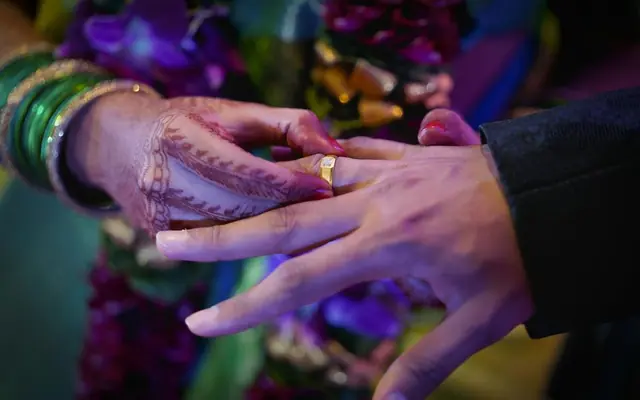
A Mangni or Sagai is bigger. This is the formal ring exchange, and the guest list expands accordingly. The invitation should name both families prominently, include the ring exchange timing (guests plan around this moment, not the general start time), and include a dress code if families are coordinating colours. A Sagai where the bride's side is wearing coral and the groom's side is wearing blue-green needs that detail in the invitation. Otherwise guests arrive in random outfits and the photos look chaotic.
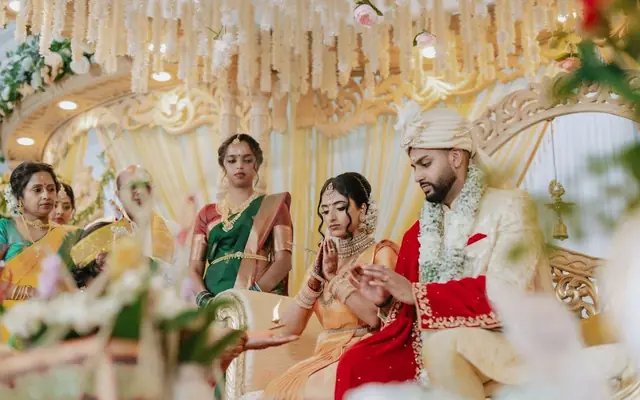
A Nishchayathartham or ring ceremony in South Indian families has a distinct ceremonial weight. These invitations should carry both family names in full, acknowledge the auspicious occasion clearly, and include the muhurat time if one has been set. Leaving out the muhurat from a Nishchayathartham invitation is the equivalent of leaving out the venue: it is the most critical piece of timing information for guests who take the ceremony seriously.
In all cases, use the term your family actually uses. If your family says "Sagai," write Sagai. If they say "ring ceremony," write ring ceremony. Borrowing a more formal or more casual term from a template creates a small but noticeable disconnect that guests feel even if they cannot name it.
The photo, the music, and the one line that makes it personal
The photo is the most important creative decision in a digital engagement invitation. Not because guests will not attend if the photo is bad, but because the photo is what people actually remember about the invitation. A month after the ceremony, ask any guest what the invitation looked like: they will describe the photo, not the font.
What works: a photo where both people look genuinely happy, in natural light, doing something that is normal for them. The Coorg road trip photo from the Pune couple. A photo from a chai stall in Banaras. A candid from a friend's wedding where the two of them are talking in the background. The photo does not need to be professionally shot. In fact, overly posed studio photos often work less well because they look like every other engagement announcement.
What does not work: photos taken in dim indoor light where faces are hard to see, photos where one person looks significantly more dressed up than the other (it looks like two different shoots spliced together), and stock-style photos where both people are looking at the camera with the same stiff smile. Guests can tell the difference between a photo that was taken for the invitation and a photo that was simply good enough to use.
Background music is the detail that most couples skip and then regret. An engagement invitation with music that actually matches the couple (not generic instrumental, but something they would actually listen to) creates an atmosphere from the moment the page opens. The invitation becomes an experience rather than a notice. Couples who pick music they love report that guests mention it at the event: "I loved what was playing when I opened the link." Couples who leave it on default or skip it report no such feedback, because there is no feedback to give.
The one line that makes it personal can be anywhere in the invitation: in the host note, in the couple's message, even in the music choice. It just needs to be true. "We met at a bad corporate event and now we're the best thing that happened to each other" is a real line from a real invitation on ShareInvite. Guests remember it because it sounds like a real person said it.
How to include both families without making the invitation look like a company memo
The standard format for including both families is: "The family of [Bride's Name] ([Father's Name] and [Mother's Name] of [City]) along with the family of [Groom's Name] ([Father's Name] and [Mother's Name] of [City]) joyfully invite you." This format works. It is the clearest, most symmetrical way to give both families equal prominence, which matters to everyone involved even when nobody says so explicitly.
The mistake is when this section grows. Names of grandparents, uncles and aunts, siblings with their own titles, sometimes all appearing before the actual event details. This turns the top of the invitation into a family census that guests scroll through to find the date. Keep the host section to the parents and, if it is the tradition of the family, the paternal grandparents. Everyone else gets acknowledged through their presence at the event, not through the invitation text.
For families from different cities or different states, including the city matters. "The family of [Name], Jaipur" and "the family of [Name], Hyderabad" communicates that two families from different parts of India have come together, which adds context and warmth. For families of the same city, the city is less necessary and can be dropped.
When both families have distinctive last names or community backgrounds that guests would recognise (a Reddy family and an Iyer family at a cross-community engagement, for example), the names carry cultural information that guests find meaningful. Do not hide this behind generic phrasing. Let the names speak.
The couple themselves can appear either below the family names or leading the invitation, depending on who is driving the narrative. A parent-led ceremony typically has parents listed first with the couple below. A couple-led engagement where they are organising and paying for the event can reasonably lead with their own names and list parents below as "hosted with love by [parent names]." Both formats are appropriate. Pick the one that accurately reflects who is actually throwing the event.
What the wish section does that nothing else in an invitation can
There is a specific type of guest at every Indian engagement: the relative or close friend who cannot travel. The grandparent in another city. The childhood friend now living abroad. The college batch mate with a newborn at home. These people would come if they could, and they feel their absence from the event. The wish section in a digital engagement invitation is the only part of the invitation that reaches back to them.
When you enable the wishes section on an engagement invitation, something shifts. Guests do not just receive the invitation. They participate in it. They leave a message. And those messages accumulate before the event happens, so the couple and family can read through them at any point. At the event itself, a family member who flew in from the US and a cousin who could not leave work both appear in the same section, with equal presence. Distance stops being a reason for absence from the celebration.
The wish section also does something unexpected for the guests who do attend. Seeing that forty people have already left wishes before they arrive makes the event feel significant in a way that a headcount cannot. It is social proof of a different kind: not numbers, but names and faces and specific messages. "Your grandmother wrote something in Tamil, the whole family cried" is a real account from a ShareInvite engagement. The grandmother was in Coimbatore. She had never typed a wish on a digital platform before. The couple still have the message.
One practical point: wishes appear on the page the moment a guest sends them, so keep half an eye on the section as the invitation circulates. Any wish can be removed from your dashboard in a couple of taps, which is occasionally worth doing if a family dispute arrives disguised as a blessing. Enable the section, but stay involved with it.
Quick checklist
- Use a real photo of the couple: a candid in natural light outperforms a formal portrait almost every time.
- Use the ceremony name your family actually uses: Roka, Mangni, Sagai, Nishchayathartham, ring ceremony.
- Include both families' names with equal prominence. Never list one as a footnote to the other.
- Add the ring exchange timing to the schedule separately from the general start time.
- Choose background music that actually matches the couple's taste, not a generic instrumental.
- Enable the wishes section so guests who cannot travel can still participate.
- Include a Google Maps link to the exact venue entrance, not just the address text.
- Write one personal line somewhere in the invitation that sounds like a real person said it.
Frequently asked questions
A Roka is the earliest and most intimate ceremony: the family agreement moment, usually with only immediate family. The invitation should be warm and brief, reflecting the small gathering. A Mangni is the formal ring exchange, more widely celebrated, with a larger guest list and a fuller event schedule. Sagai is the North Indian equivalent of Mangni, a ring exchange that marks the official engagement, typically with both families present and a meal or event following. Nishchayathartham is the South Indian (primarily Telugu) formal engagement ceremony, often with a set muhurat time. Ring ceremony is the English term most urban families use and is interchangeable with Mangni or Sagai in casual usage. The key is to use the term your family actually uses: the invitation should feel like it came from your house, not from a template library.
A casual photo in good natural light almost always outperforms a formal studio portrait for engagement invitations. The reason is simple: guests can tell when a photo is real, and a real photo communicates that the couple is genuinely happy together. A studio portrait can look stiff (both people dressed up, facing the camera in a specific pose), and it reads as an announcement rather than an invitation. The best engagement invitation photos are ones where both people are clearly comfortable: a trip photo, a festival photo, even a good phone photo from an ordinary day. If you have had a professional pre-wedding shoot, use the candid frames from that shoot rather than the posed ones.
Send the engagement invitation 10 to 14 days before the ceremony for a local guest list. If family is travelling from another city (which is common for Indian engagements, especially when both families are from different states), send it 3 to 4 weeks in advance. The engagement is often a one-time date tied to family schedules, muhurat, or venue availability, so guests have less flexibility than they might for other events. Give out-of-city guests maximum lead time. A digital invitation can be created in an hour, so there is no reason to wait until a week before and then scramble.
Yes, and this is increasingly the norm. The format that works best for co-hosted engagements lists both families symmetrically: "The family of [Bride's Name] and the family of [Groom's Name] joyfully invite you." Each family can then be listed by the parents' names below. Avoid the format where one family is listed fully and the other appears as a brief afterthought. Guests notice, and so will the family whose names are smaller. For couples who are co-hosting independently of parents (planning and paying for the event themselves), leading with the couple's names and listing parents below as "hosted with love by [parent names]" is entirely appropriate and increasingly common for urban Indian engagements.