South Indian wedding invitations have their own visual and structural conventions, and most "Indian wedding invitation" advice is written for North Indian weddings. The ceremony names differ, the timings differ, the muhurat matters more, and the design vocabulary draws on temple architecture rather than Mughal court motifs. Modern South Indian invitations are moving away from the dense, text-heavy format toward cleaner layouts — but the information density was never decorative. A Tamil or Telugu wedding invitation carries gotra references, ancestral details and a sequence of ceremonies that guests genuinely use. Here is how to modernise the design without losing what the format is for.
What the traditional format carries
Before simplifying, it helps to know what each block does.
The invocation names the family deity or opens with a line to Ganesha, and it sets the religious register.
The ancestral and family details — grandparents' names, native place, sometimes gotra — establish lineage. In many communities this is not ornamental; guests read it to place the family.
The muhurat is stated precisely, often to the minute, because it is astrologically determined and the ceremony begins at that moment. This is the single most important time on the invitation.
The ceremony sequence typically spans two or three days: Nischayathartham or engagement, Kashi Yatra, Muhurtham, Reception. Each has a time and often a different venue.
Modernising means presenting these more clearly, not dropping them. A cleaner layout that omits the muhurat has made the invitation worse.
A modern layout that keeps the substance
The structure that works on a phone, top to bottom.
Invocation, brief and centred. One line, given space.
The couple's names, large. This is the focal point in a modern layout, where traditional invitations often placed family details first.
Family details, immediately below, in a smaller but clearly legible size. Both sets of parents, and grandparents or native place where that is the family custom. This is where modern designs most often over-compress — the text goes too small and older guests cannot read the names they are looking for.
The muhurat, set apart in its own block with the date, exact time and venue. Give it visual weight; it is what guests come back to check.
The full ceremony sequence as a timeline, each event with its own time and venue.
Then gallery, directions and wishes.
The change from traditional is mostly hierarchy and spacing rather than content.
Design vocabulary
The South Indian visual register draws on different sources from the North Indian palace style.
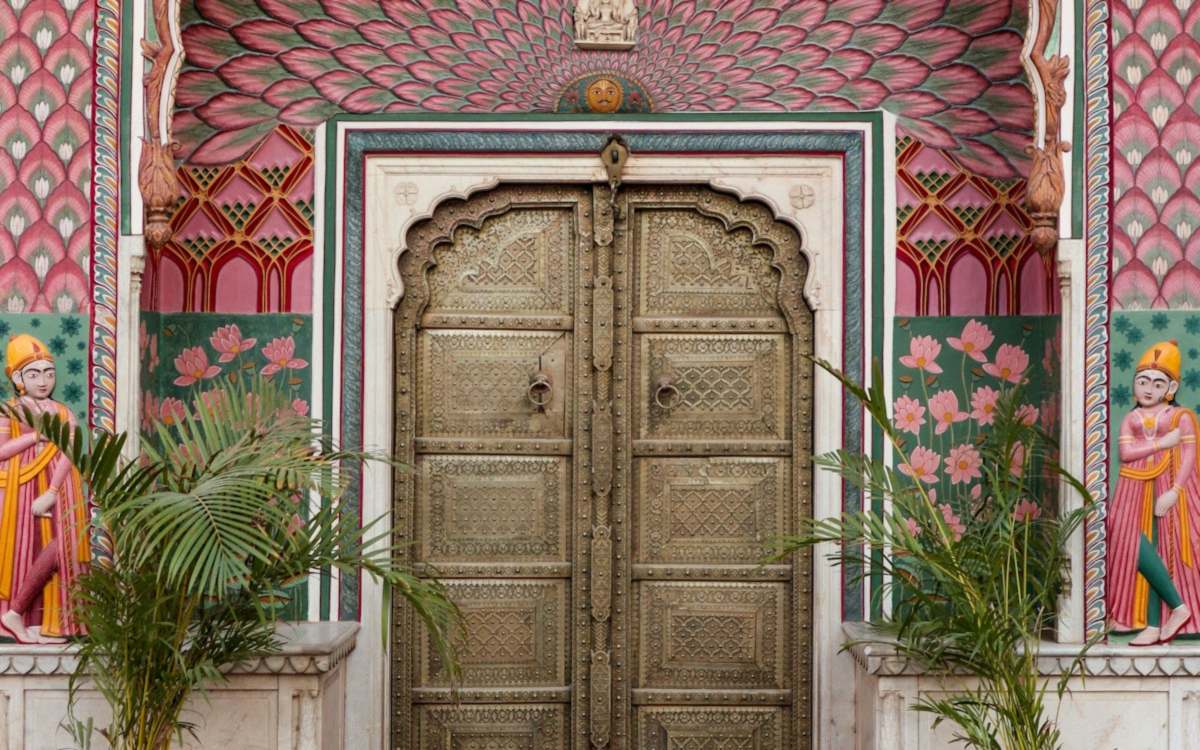
Temple architecture — gopuram silhouettes, pillar forms, stepped outlines. These read as distinctly South Indian and work well as a frame or a section divider.
Kolam and rangoli geometry — linear, symmetrical, mathematical. Kolam patterns work particularly well as subtle section breaks, because they are line-based and stay legible at small sizes where a dense floral motif would blur.
Temple jewellery motifs — mango, lakshmi coin, jasmine. Strong at small scale as a repeated element.
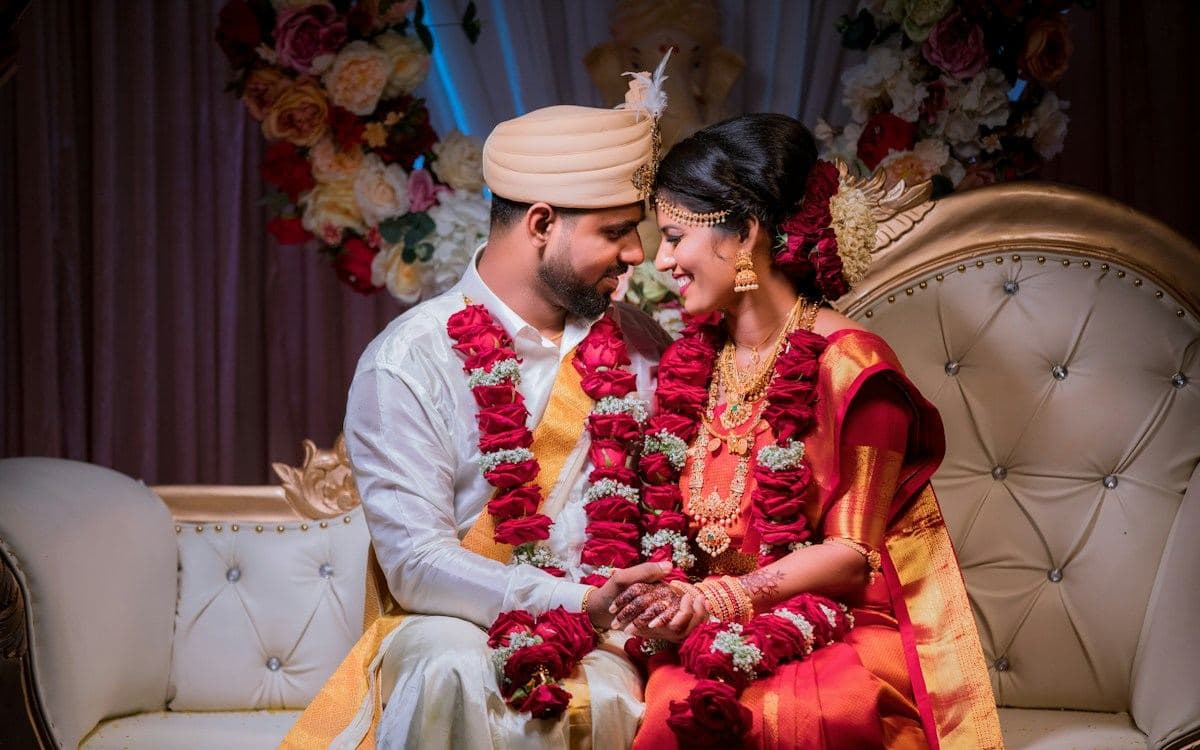
Colour: deep maroon and gold remains the classic; mustard and teal, and off-white with temple gold, are the contemporary alternatives. Kanjeevaram palettes translate well to screens, since they are built on strong contrast between a saturated body colour and a gold border.
Use one vocabulary consistently. A gopuram silhouette with a Mughal jaali border reads as generic.
Practical details specific to these weddings
Four things that matter more at South Indian weddings than the general advice suggests.
Early timings. Muhurtham is frequently between 5 AM and 9 AM. Guests are travelling in darkness, so the invitation should state arrival time explicitly and, where possible, whether transport is arranged.
Multi-day and multi-venue. The ceremonies often span two or three days at different venues, sometimes in different towns. Each function needs its own Maps pin, not one link for the wedding.
Sadhya timing. Guests plan around the meal, and lunch is usually a fixed sequence rather than an open buffet. Saying when sadhya is served is genuinely useful.
Language. If the invitation carries Tamil, Telugu, Kannada or Malayalam text alongside English, verify the font renders correctly on an actual phone — a missing glyph in a family name is a serious error, and Indic font fallbacks are inconsistent across Android devices.
Quick checklist
- Keep the invocation, family details and gotra or native place
- State the muhurat to the minute, in its own block
- Keep family details legible — do not over-compress them
- Give each function its own time, venue and Maps pin
- Choose one design vocabulary: temple, kolam or jewellery motifs
- State arrival time for early-morning muhurtham
- Say when sadhya is served
- Verify Indic fonts render on a real Android phone
Frequently asked questions
The invocation, both sets of parents and often grandparents or the native place, the muhurat stated precisely, and the full ceremony sequence — commonly Nischayathartham, Kashi Yatra, Muhurtham and Reception — each with its own time and venue. The family details are not decorative; guests read them to place the family, so they should stay legible rather than being compressed to make room.
Change the hierarchy and spacing rather than the content. Lead with the couple’s names at a large size, put family details clearly beneath, give the muhurat its own visual block, and present the ceremony sequence as a timeline. A cleaner layout that drops the muhurat or shrinks the family names has made the invitation less useful, not more modern.
Temple architecture such as gopuram silhouettes and pillar forms, kolam geometry, and temple jewellery motifs like mango and jasmine. Kolam patterns work especially well as section dividers because they are line-based and stay legible at small sizes. Kanjeevaram-inspired palettes translate well to screens, being built on strong contrast between a saturated colour and gold.
Early muhurtham timings mean guests travel before dawn, so state arrival time and any transport arrangements. Ceremonies often span several days and venues, so each function needs its own Maps pin. Say when sadhya is served, and if the invitation includes Tamil, Telugu, Kannada or Malayalam text, check it renders on a real Android phone — Indic font fallbacks are inconsistent.